Diagnose in the order light travels
Before assuming failure, establish what the unit did on day one. Most gobo artwork mistakes complaints describe a gradual decline that nobody dated, which makes it impossible to tell a failing LED from a dirty lens. Take a photo, note the hour and the house lighting, and compare against the install record.
- What the surface looks like and how it is lit
- Whether the image is uniformly soft or soft at one edge
- When the fault started — overnight or gradually
- Whether anything on site changed at the same time
The image is soft or out of focus
Blur has three causes and only one needs a new part. First, focus drift — housings expand as they warm and short throws are more sensitive than long ones. Second, an off-axis mount, where one side of the image is genuinely further away than the other and no focus setting fixes both. Third, a surface that is not flat, which scatters the image at the edges.
- Refocus at the working hour on the actual surface
- Check the corners — soft corners mean an angled mount
- Confirm the surface is flat
- Inspect the lens and gobo for contamination
Dim: ambient light, output and dirty optics
Dimness is almost always an ambient light problem wearing a hardware disguise. Before changing the gobo artwork mistakes, measure what is already falling on the surface: if house lighting changed, a display moved, or the unit is now running an hour earlier, the projector has not got worse — the room has got brighter. The second most common cause is a dirty lens or a filter that has lost transmission.
- Clean the outer window and lens
- Measure ambient light at the working hour
- Reduce the image width and re-check contrast
- Run a full duty cycle and log the housing temperature
Colour is wrong or the gobo looks damaged
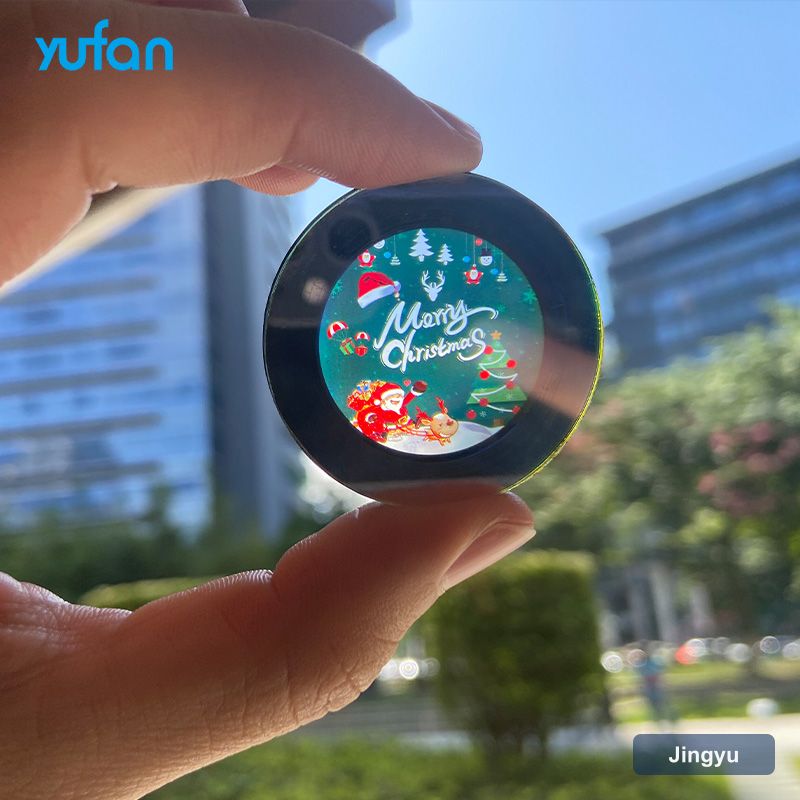
Most colour complaints turn out to be artwork, not hardware. A gobo engraved from a low-resolution file, or one where a gradient was converted to a coarse halftone, produces banding and muddy edges that look like a projector fault. Check the original file before ordering replacement optics.
- Compare against the install photograph
- Decide whether the whole image or part of it is affected
- Inspect the gobo against a light at an angle
- Check the original artwork file resolution
Electrical and thermal symptoms
Intermittent faults are thermal or connection problems. A gobo artwork mistakes that runs for an hour then cuts out is overheating or has a marginal supply; one that hums has a driver or a transformer under load; one that trips a breaker usually has a genuine earth fault or an over-sized protective device. Log when it happens — after warm-up, at switch-on, or at random — and the pattern identifies the cause.
- Note when the fault occurs — at switch-on or after warm-up
- Measure the supply at the unit under load
- Check the housing temperature and ventilation
- Confirm the protective device is correctly sized