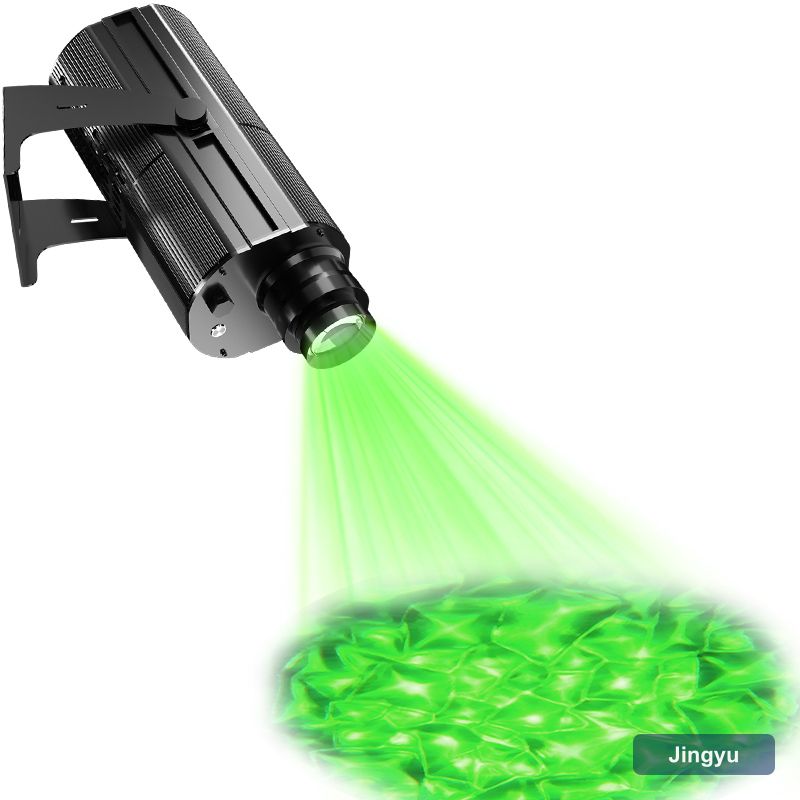
Diagnose in the order light travels
Diagnose in the order the light travels: surface, then focus, then gobo, then lamp, then power. That sequence finds most outdoor logo projector light faults in under an hour, and it prevents the common mistake of replacing a perfectly good unit because the wall turned out to be the problem. Start by asking what changed — a fault that appeared overnight has a different cause from one that crept in over a season.
- What the surface looks like and how it is lit
- Whether the image is uniformly soft or soft at one edge
- When the fault started — overnight or gradually
- Whether anything on site changed at the same time
The image is soft or out of focus
Blur has three causes and only one needs a new part. First, focus drift — housings expand as they warm and short throws are more sensitive than long ones. Second, an off-axis mount, where one side of the image is genuinely further away than the other and no focus setting fixes both. Third, a surface that is not flat, which scatters the image at the edges.
Dim: ambient light, output and dirty optics
Before blaming the LED, clean the optics and check the duty cycle. an outdoor logo projector light that runs hot in an enclosed void will dim progressively as the driver protects itself, and the symptom looks exactly like lamp wear. Logging the housing temperature over a full evening will separate the two.
- Clean the outer window and lens
- Measure ambient light at the working hour
- Reduce the image width and re-check contrast
- Run a full duty cycle and log the housing temperature
Colour is wrong or the gobo looks damaged
Most colour complaints turn out to be artwork, not hardware. A gobo engraved from a low-resolution file, or one where a gradient was converted to a coarse halftone, produces banding and muddy edges that look like a projector fault. Check the original file before ordering replacement optics.
It cuts out, hums or trips
Note the timing. Cut-out after 60–90 minutes is thermal; a trip at switch-on is inrush or a wiring fault; a hum that appears only at full output is the driver. All three are fixable without replacing the outdoor logo projector light, but all three get misdiagnosed as a dead unit when nobody records when the fault occurs.
- Note when the fault occurs — at switch-on or after warm-up
- Measure the supply at the unit under load
- Check the housing temperature and ventilation
- Confirm the protective device is correctly sized
What to have ready before you call
Stop diagnosing and call when you have eliminated the three cheap causes: contamination, ambient light and supply. Before you do, gather the serial number, the install date, and a photograph of the image on the wall at the working hour. A supplier can usually resolve it from those without a site visit.
- Model and serial number
- Install date and daily run hours
- Throw distance and image width
- A photograph of the fault at the working hour