Start from the wall and work backwards
Nothing on a spec sheet is dishonest; plenty of it is irrelevant. A monogram gobo projector sheet will quote lumen output, power draw and beam angle, but what you need is image width at your throw distance and contrast against the light already on the surface. Those require two more numbers the sheet usually does not give you, which is why they are worth asking for.
Lumens, watts and what reaches the wall
Three output figures get mixed up constantly: lumens describe what the lamp produces, lux describes what arrives on the surface, and watts describe what you pay for. A monogram gobo projector drawing 20–60 W might deliver 3,000 lumens, but the lux at the wall depends entirely on how wide you spread it. The same lamp projecting a 1 m image is nine times brighter than the same lamp projecting a 3 m image.
The two numbers that must be quoted together
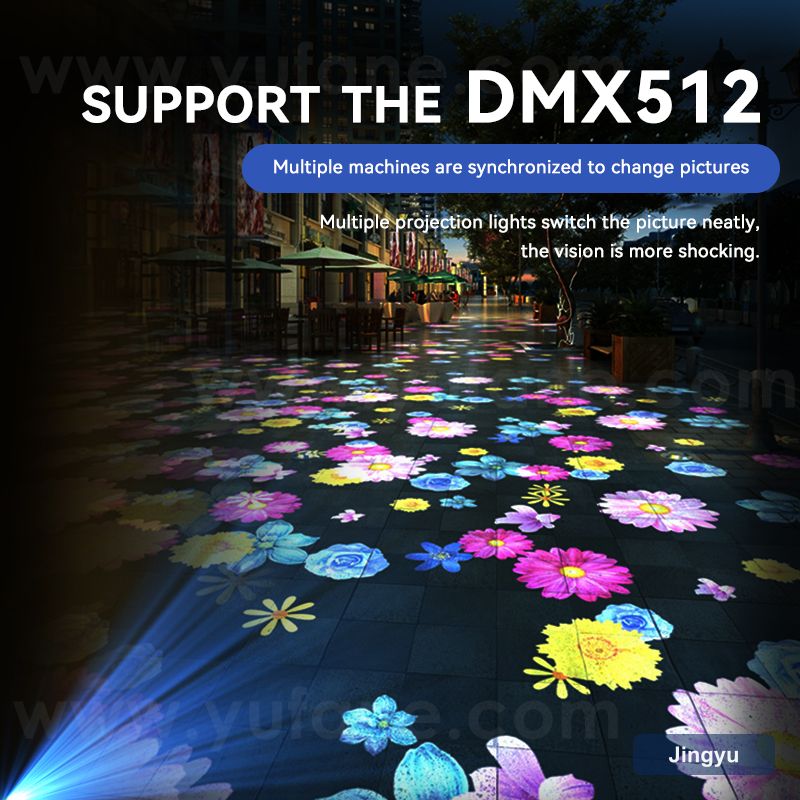
Throw distance without image width is meaningless, and plenty of sheets quote only one. A monogram gobo projector that throws 10 m might give you a 1 m logo at that distance or a 6 m one, depending on the lens — a difference that decides whether the install works. Always ask for the pair: distance and the resulting image size.
| Throw | Typical image width | Practical note |
|---|---|---|
| Short, around 2 m | 0.5 – 1.5 m | Bright and easy — most indoor work |
| Mid, around 10 m | 1.5 – 3 m | Where lens quality starts to matter |
| Long, beyond 10 m | 3 m and up | Contrast fails before reach does |
Gobo size, image area and resolution
Gobo size is quoted as an outer diameter, but what matters is the image area — the part the light actually passes through. A 53 mm gobo may only have a 45 mm image circle, and artwork sized to the outer diameter gets cropped. For a monogram gobo projector, ask for both figures before you commission artwork, because a file drawn for the wrong one is wasted.
IP rating and electrical data
The electrical block is boring and expensive to get wrong. Confirm the input voltage range matches your supply, check whether the monogram gobo projector ships with a local plug, and look for CE, RoHS and FCC marks if the install is commercial. A unit that is electrically fine but uncertified will not pass a site inspection in most markets.
Questions worth asking the supplier
Four questions separate a supplier who knows the product from one reading a sheet. What is the image width at my throw distance? What is the gobo image area? Is the IP20 rating for the housing alone or the whole assembly? And what is the lead time on a replacement gobo? A good supplier answers all four in one reply.