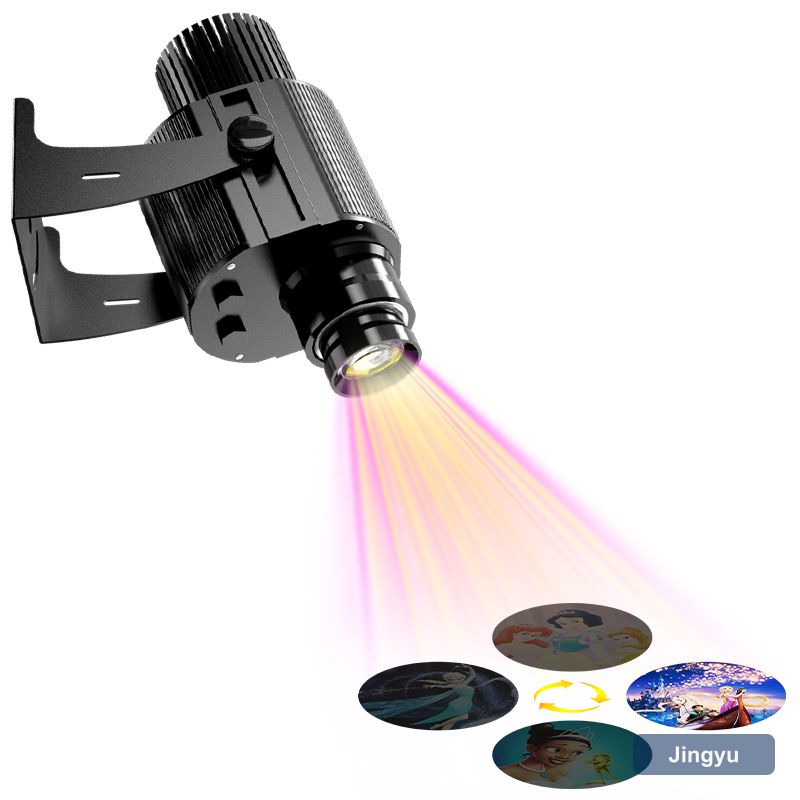
Diagnose in the order light travels
Diagnose in the order the light travels: surface, then focus, then gobo, then lamp, then power. That sequence finds most static gobo projector faults in under an hour, and it prevents the common mistake of replacing a perfectly good unit because the wall turned out to be the problem. Start by asking what changed — a fault that appeared overnight has a different cause from one that crept in over a season.
Blur: focus, surface and lens
Blur has three causes and only one needs a new part. First, focus drift — housings expand as they warm and short throws are more sensitive than long ones. Second, an off-axis mount, where one side of the image is genuinely further away than the other and no focus setting fixes both. Third, a surface that is not flat, which scatters the image at the edges.
- Refocus at the working hour on the actual surface
- Check the corners — soft corners mean an angled mount
- Confirm the surface is flat
- Inspect the lens and gobo for contamination
The image is too dim
Check the easy things in order: lens cleanliness, ambient light at the working hour, image size. Halving the image area doubles the brightness at the wall, which is free. Only after those should you consider a higher output model — and if you do, note that going from 20 W to 150 W is a visible but not dramatic change.
Colour is wrong or the gobo looks damaged
If the whole image has shifted, suspect the filter; if only part has, suspect the gobo. Dichroic coatings are stable for years, but dyed glass browns under heat, and a static gobo projector running at the top of its range will age a cheap filter in a single season. Photograph the image against a white reference and compare it with the install photo.
- Compare against the install photograph
- Decide whether the whole image or part of it is affected
- Inspect the gobo against a light at an angle
- Check the original artwork file resolution
Electrical and thermal symptoms
Note the timing. Cut-out after 60–90 minutes is thermal; a trip at switch-on is inrush or a wiring fault; a hum that appears only at full output is the driver. All three are fixable without replacing the static gobo projector, but all three get misdiagnosed as a dead unit when nobody records when the fault occurs.
- Note when the fault occurs — at switch-on or after warm-up
- Measure the supply at the unit under load
- Check the housing temperature and ventilation
- Confirm the protective device is correctly sized
When to stop and call the manufacturer
Call the manufacturer when the fault survives the sequence: optics cleaned, focus reset at the working hour, ambient light measured, and supply checked under load. Have the model, the install date, the throw distance and a photo of the image ready — that is enough for a supplier to tell you whether it is a warranty matter or a site issue.
- Model and serial number
- Install date and daily run hours
- Throw distance and image width
- A photograph of the fault at the working hour