What this fixture is good at
The applications that work share one property: the surface is controlled. Where a rotating gobo projector succeeds — a retail window, an event stage — somebody has thought about what is already falling on that wall. Where it fails, the unit is fighting daylight or a glossy, patterned surface it was never going to win against.
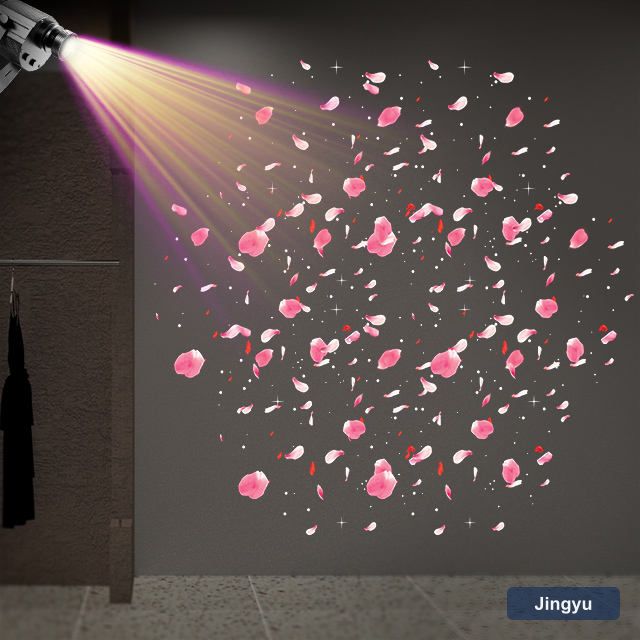
retail window: the straightforward install
A retail window install is the reference case: controlled surface, predictable light, fixed message. A rotating gobo projector in this setting usually runs at the lower end of its output range, which extends LED life and keeps the housing cool — the two things that determine whether it is still running in five years.
Application two — event stage
In an event stage the competition is ambient light, and brute force is the expensive answer. Before moving from 30 W to 200 W, try relocation: a darker corner of the same wall, a surface angled away from the main fittings, or a slightly smaller image. Halving the image area doubles the brightness for free.
Application three — building facade
On a building facade, expect to give ground on image size to get contrast. A rotating gobo projector asked to cover a large area in difficult light will produce something technically correct and visually useless. Reduce the image width until it reads, accept the smaller footprint, and if that is not enough, the honest answer is that projection is the wrong tool here.
Recommended configuration by application
Match the configuration to the surface: matte and light-coloured surfaces give the most back, glossy or dark ones eat the image. On difficult surfaces, reduce the image size before increasing the power — it is cheaper and it works.
| Application | Recommended output | Notes |
|---|---|---|
| retail window | 30 W class | Controlled surface, short throw |
| event stage | 30–200 W | Competing with existing lighting |
| building facade | 200 W and up | Reduce image size before adding power |
Three site questions
Before committing, answer three questions about the site: how bright is the surface at the working hour, can the unit be mounted square to it, and is there power within reach. If all three are favourable, a rotating gobo projector will do the job. If two are not, price the alternatives first.