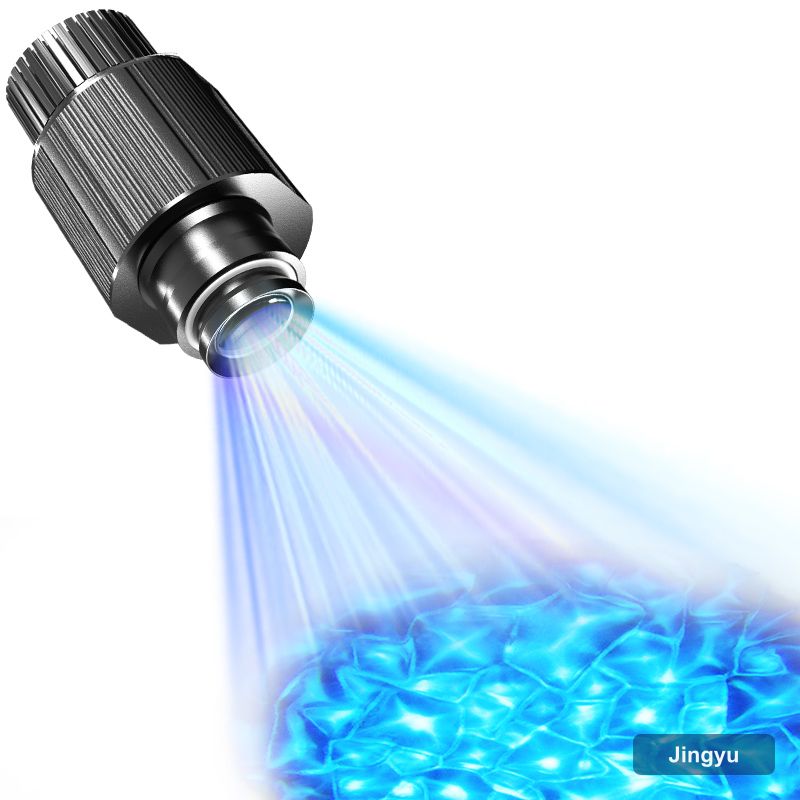
Survey before you drill
Installations go wrong in the first hour, on the survey, when somebody decides where the bracket goes before checking what is behind the wall. Before you drill for an IP65 gobo light projector, confirm four things: the power position, what the surface is made of, whether the mounting point can carry the weight, and where the image will actually land once the furniture and signage are in place.
Mounting height and bracket choice
Aim for a straight-on shot and a reachable position. The geometry matters more than people expect: at 30 degrees off-axis a rectangular logo becomes visibly trapezoidal, and no amount of focus adjustment fixes it. If the only available position is steeply angled, plan the artwork to suit — or move the surface.
- Bracket rated above the fixture weight
- Stainless fixings for exposed positions
- Beam as close to perpendicular as the site allows
- Position reachable without powered access
Aiming, zooming and focusing
Adjust in this order: position, zoom, focus, then rotation. Moving the bracket after you have focused wastes the whole sequence, so get the geometry settled first. On an IP65 gobo light projector, set the zoom to frame the image on the target surface, then focus at the centre of the image and check the corners — if the corners are softer than the centre, the beam is off-axis.
- Set the bracket position first
- Zoom to frame the image on the surface
- Focus at the centre, then check all four corners
- Lock the focus if the unit allows it
Power, cable routing and switching
Fit the cable gland the right way up and leave a drip loop. Those two details prevent most of the water ingress calls on outdoor IP65 gobo light projector installs. Then confirm the supply is switched and labelled, so the site team can isolate the unit without hunting through a distribution board.
- Fixed, switched, protected supply
- Cable gland rated for the environment, fitted with a drip loop
- Run out of reach and out of the cleaning route
- Connection point accessible without dismantling the unit
Test it the way it will be used
Test the way it will be used, not the way it was installed. Run the IP65 gobo light projector at the hour it is meant to run, with the house lights at their normal setting, and look at the image from where the audience will stand. A unit that looks fine at 2pm in an empty room can be invisible at 7pm with the lights on.
- Image sharpness at the centre and all four corners
- Contrast against the surface at the working hour
- Full duty cycle run without thermal cut-out
- Housing temperature after an hour at full output
Handover notes worth leaving behind
Write down the settings. an IP65 gobo light projector reinstalled after decoration, or a second unit ordered to match the first, is only reproducible if somebody recorded the throw, the lens setting and the gobo reference. Put it in the site folder and send a copy to whoever will order the replacement.