Why the unit price misleads
There are four cost lines and only one of them is negotiable after delivery. Hardware is bought once, artwork is bought repeatedly, installation is bought on site, and running cost is bought every month. Understanding which is which is what makes a gobo projection light budget accurate.
- Hardware — the fixture, lens and bracket
- Custom artwork — the gobo, and every re-cut after it
- Installation — access, power and making good
- Running cost — cleaning, power and replacement cycles
Hardware
Hardware scales with output and rating. A gobo projection light at the bottom of the 25–250 W range for a sheltered indoor position is a different product from one at the top of the range rated IP65 for an exposed facade — same category, very different bill. The jump is driven by the LED, the driver, the thermal design and the housing, in that order.
- Output, which sets the LED, driver and heatsink size
- Ingress rating, which sets the sealing and housing design
- Lens quality, which sets how much output reaches the wall
- Finish and hardware, which set how it survives the site
| Specification | Lower cost | Higher cost |
|---|---|---|
| Output | 25 W class | 250 W and above |
| Ingress rating | Indoor rated | IP65 for exposed positions |
| Optics | Fixed lens | Zoom with lockable focus |
| Artwork | Metal gobo | glass gobo with fine detail |
Custom artwork and gobos
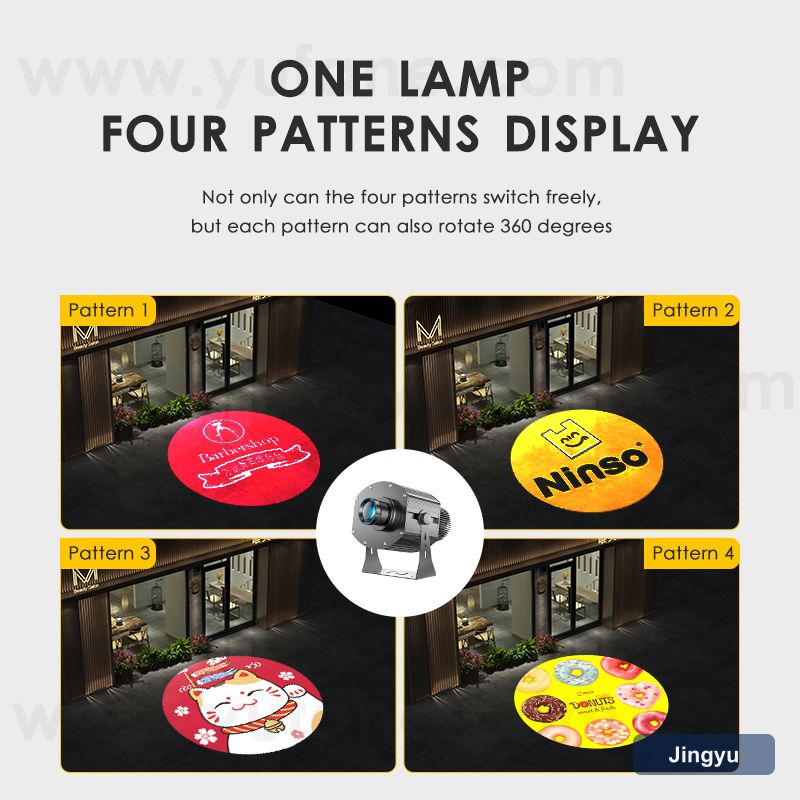
Budget for artwork as a subscription, not a purchase. A single gobo projection light might need one gobo in five years; a twenty-site rollout will need dozens, and every one of them is a small project with artwork, proofing and shipping. Standardising the file and the size is the single biggest saving available.
- Engraving per unit, and any minimum quantity
- Artwork preparation if the supplied file needs work
- Shipping, especially on small reorders
- Lead time, and the cost of waiting
The line that surprises people
Price the site, not the fixture. Two identical gobo projection light installs can differ by a factor of three depending on access, power availability and whether work has to happen outside trading hours. Get that number before the order, not after.
- Access equipment — ladder, scaffold or powered platform
- Power run and any making good afterwards
- Out-of-hours or trading-hours working
- Fixings, bracket and cable management
Total cost of ownership
The three-year picture: hardware once, artwork a few times, cleaning twice a year, power continuously. Of these, the one buyers underestimate is cleaning — and the one that decides it is whether the unit can be reached with a ladder.
| Cost line | Frequency | What drives it |
|---|---|---|
| Hardware | Once | Output and ingress rating |
| Artwork | Every rebrand or new site | Number of sites and change frequency |
| Cleaning | Twice a year | Access method, mostly |
| Power | Continuously | Wattage and daily run hours |
Cuts that cost you later
Spend on the survey and the artwork, save on the headline wattage. A correctly sized gobo projection light, aimed at a well-chosen surface, beats an over-specified one pointed at the wrong wall — and costs less to buy and to run.
- Reduce the image size before increasing the output
- Standardise the gobo size across every site
- Choose a surface with lower ambient light
- Keep the original vector artwork file