Why the unit price misleads
Buyers compare the hardware price and then discover the artwork, the mounting hardware and the access costs. an event gobo projector is a system: light source, optics, a piece of custom glass, a bracket and somebody's time on a ladder. Quoting only the first of those produces budgets that do not survive the first year.
What you pay for the fixture
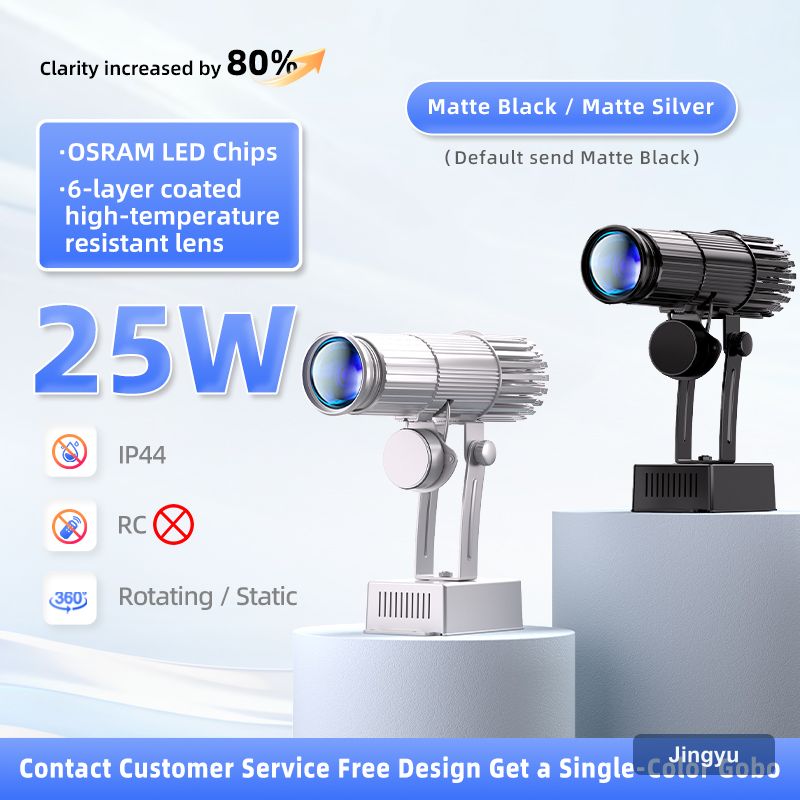
Two things move the hardware price: watts and ingress rating. Output costs money because it needs a bigger LED, a better driver and more heatsink; IP44 costs money because it needs sealing, gaskets and a design that survives being opened. Neither is worth skimping on if the site demands it, and neither is worth paying for if it does not.
- Output, which sets the LED, driver and heatsink size
- Ingress rating, which sets the sealing and housing design
- Lens quality, which sets how much output reaches the wall
- Finish and hardware, which set how it survives the site
| Specification | Lower cost | Higher cost |
|---|---|---|
| Output | 30 W class | 150 W and above |
| Ingress rating | Indoor rated | IP44 for exposed positions |
| Optics | Fixed lens | Zoom with lockable focus |
| Artwork | Metal gobo | glass gobo with fine detail |
The recurring line
The artwork cost hides in the reorders. Engraving a glass gobo is not expensive per unit, but minimum quantities, shipping and the time spent re-approving artwork add up. Keep the original vector file, record the gobo reference, and every future reorder is a formality rather than a redesign.
- Engraving per unit, and any minimum quantity
- Artwork preparation if the supplied file needs work
- Shipping, especially on small reorders
- Lead time, and the cost of waiting
Installation, power and access
Installation is where budgets break, because it depends on the site rather than the product. Access equipment, a new power run, out-of-hours working and making good afterwards are all variable and none of them appear in an event gobo projector quote. Survey before you commit, and price the access separately.
- Access equipment — ladder, scaffold or powered platform
- Power run and any making good afterwards
- Out-of-hours or trading-hours working
- Fixings, bracket and cable management
Running cost over three years
Total cost is dominated by whatever you have to do most often. If the event gobo projector is easy to reach, cleaning is trivial and cheap; if it needs scaffolding, it gets deferred, output declines, and eventually somebody replaces a unit that only needed a wipe. Design for access and the running cost halves.
- Hardware, once
- Artwork reorders, every rebrand or new site
- Cleaning, twice a year
- Power, continuously
| Cost line | Frequency | What drives it |
|---|---|---|
| Hardware | Once | Output and ingress rating |
| Artwork | Every rebrand or new site | Number of sites and change frequency |
| Cleaning | Twice a year | Access method, mostly |
| Power | Continuously | Wattage and daily run hours |
Cuts that cost you later
Save on image size, not on output. Halving the projected area doubles the contrast at the wall for nothing, and it lets a smaller event gobo projector do the same job. Do not save on the ingress rating, the bracket, or the artwork file — those three cuts cost more than they save within two years.
- Halve the projected area rather than double the watts
- Pick a matte, light-coloured surface
- Mount square to the beam to avoid wasted output
- Hold the artwork file and gobo reference on record