Read the sheet in the order it is installed
Nothing on a spec sheet is dishonest; plenty of it is irrelevant. A commercial logo projector sheet will quote lumen output, power draw and beam angle, but what you need is image width at your throw distance and contrast against the light already on the surface. Those require two more numbers the sheet usually does not give you, which is why they are worth asking for.
Lumens, watts and what reaches the wall
Wattage tells you the running cost, not the result. Two commercial logo projector models at the same wattage can differ by 30% at the wall because of lens efficiency and LED binning. What you actually care about is contrast: the image needs to be meaningfully brighter than the surface it lands on, and that is a lux comparison, not a lumen one.
| Figure | What it measures | How much to trust it |
|---|---|---|
| Lumens | Total light leaving the lamp | Rough sorting tool — ignores lens and gobo losses |
| Lux at the wall | Light arriving on the surface | The number that matters, rarely quoted |
| Watts | Power drawn from the supply | Tells you running cost, not brightness |
Throw distance and image size
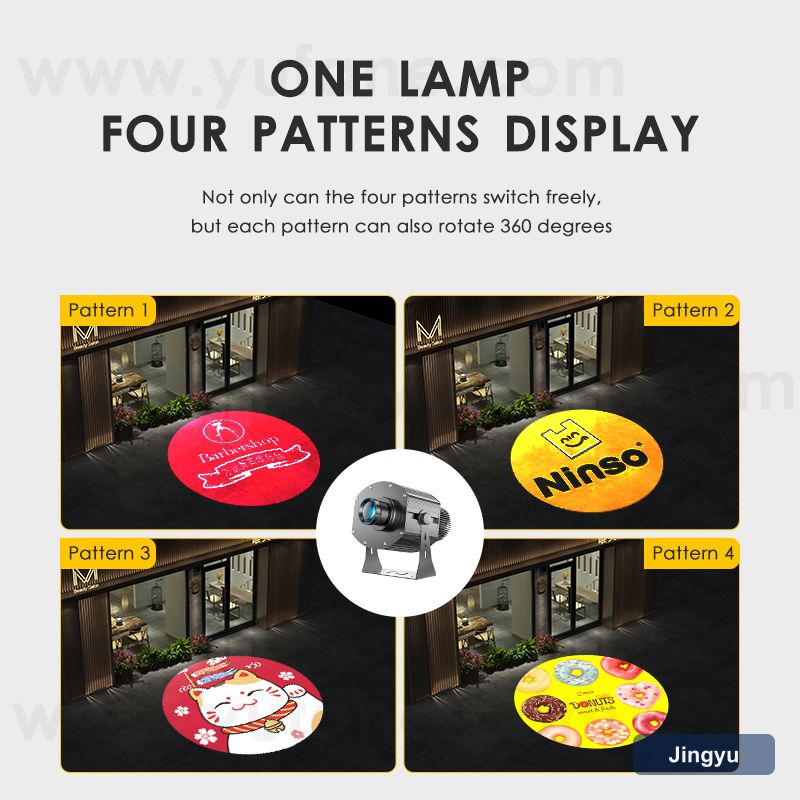
The useful specification is the throw ratio, or failing that a distance-to-image-width table. On a typical commercial logo projector covering 6–30 m, the zoom lens might take the image from roughly 0.8 m wide at the near end to 3 m at the far end. Once you know the width you need, the throw tells you where the bracket goes — not the other way round.
| Throw | Typical image width | Practical note |
|---|---|---|
| Short, around 6 m | 0.5 – 1.5 m | Bright and easy — most indoor work |
| Mid, around 30 m | 1.5 – 3 m | Where lens quality starts to matter |
| Long, beyond 30 m | 3 m and up | Contrast fails before reach does |
The optical spec most sheets leave out
The spec most sheets omit is the maximum artwork resolution the optics can resolve. A commercial logo projector with a good lens will render fine detail that a cheaper unit turns to mush, which means the limiting factor is often the projector, not the gobo. If your design has thin strokes, ask what line width the system holds at your throw distance.
IP rating and electrical data
Ratings age. A commercial logo projector that left the factory rated IP65 can lose that rating the first time somebody opens it to change a gobo and reseats the gasket badly. Look for a design where routine access does not mean breaking the environmental seal, or accept that the rating applies to the unit as delivered, not as maintained.
What a good supplier answers without hesitating
The most revealing question is about failure. Ask what the most common warranty claim on this commercial logo projector is and how it is resolved. A supplier who answers honestly is worth more than one with a slightly better spec sheet.